Design
Nano Banana Pro vs Nano Banana 2.1: Which Google Image Model Should Marketers Use?
Nano Banana Pro is Google's premium image model; Nano Banana 2.1 is the newer, cheaper workhorse. Prices, limits, a same-prompt test, and which one to use for each marketing job.

Nano Banana Pro is Google's premium image model and Nano Banana 2.1 is its newer, cheaper workhorse: use Pro for complex, brand-critical images where one great picture matters, and 2.1 for everything else, at about a quarter of Pro's price per 1K image.
Both come from Google DeepMind, both run on the Gemini API and Vertex AI, and both can put readable words into a picture. The differences are price, how many reference images each accepts and of what kind, which search tools each can use, and how much each costs you when a campaign needs dozens of variations. This guide puts Google's own documentation next to a test we ran on October 26, 2026, and ends with a plain answer for each common marketing job.
Key Takeaways
- Price: Nano Banana 2.1 costs $0.0336 per 1K image on Google's pricing page; Nano Banana Pro costs $0.134 at 1K or 2K. That is about four times as much at 1K and about twice as much at 4K.
- Positioning: Google calls Pro "the premium choice for the most complex visual tasks". 2.1 is the high-efficiency model, built for speed and volume.
- References: Pro takes up to 6 object images, 5 character images and 3 style references. 2.1 takes up to 10 object images and 4 character images, and no style references.
- Search: both can ground an image in Google web search. Only 2.1 adds Google Image Search grounding.
- Free access: neither model has a free tier in the Gemini API. In MITPO, Nano Banana 2.1 is on the Free plan at 1K; Pro starts on Starter.
What is the difference between Nano Banana Pro and Nano Banana 2.1?
Nano Banana Pro (model ID gemini-3-pro-image) is Google's top image model, and Nano Banana 2.1 (gemini-nano-banana-2.1) is its fast, low-cost model for everyday work. Google's image generation documentation describes Pro as "optimized for professional asset production" and 2.1 as "optimized for speed and high-volume use-cases".
The two arrived a year apart. Google introduced Nano Banana Pro on November 20, 2025, as a preview, and Vertex AI lists the generally available version as released on May 28, 2026. Nano Banana 2.1 followed on October 6, 2026, as an update to Nano Banana 2. We covered that launch, with our first tests, in our Nano Banana 2.1 guide for marketers.
Here is Google DeepMind's own launch video for Pro, which shows the kinds of jobs it was built for: infographics, product shots and edits that keep a person or object consistent.
Nano Banana Pro vs 2.1 at a glance
| Nano Banana Pro | Nano Banana 2.1 | |
|---|---|---|
| Model ID | gemini-3-pro-image | gemini-nano-banana-2.1 |
| Released | Preview Nov 20, 2025; GA May 28, 2026 | Oct 6, 2026 |
| Google's description | Premium choice for the most complex visual tasks | High-efficiency model for speed and volume |
| Price per image (1K / 2K / 4K) | $0.134 / $0.134 / $0.24 | $0.0336 / $0.0504 / $0.113 |
| Object references | Up to 6 | Up to 10 |
| Character references | Up to 5 | Up to 4 |
| Style references | Up to 3 | None listed |
| Google web search grounding | Yes | Yes |
| Google Image Search grounding | No | Yes |
| API free tier | Not available | Not available |
| In MITPO | 13 credits at 2K, Starter and up | 4 credits at 1K, Free plan and up |
All images from both models carry Google's invisible SynthID watermark, according to the image generation documentation.
How much does Nano Banana Pro cost compared with Nano Banana 2.1?
Nano Banana Pro costs $0.134 per image at 1K or 2K and $0.24 at 4K, while Nano Banana 2.1 costs $0.0336, $0.0504 and $0.113 at the same three sizes. These are the standard prices on Google's Gemini API pricing page, read on October 26, 2026.
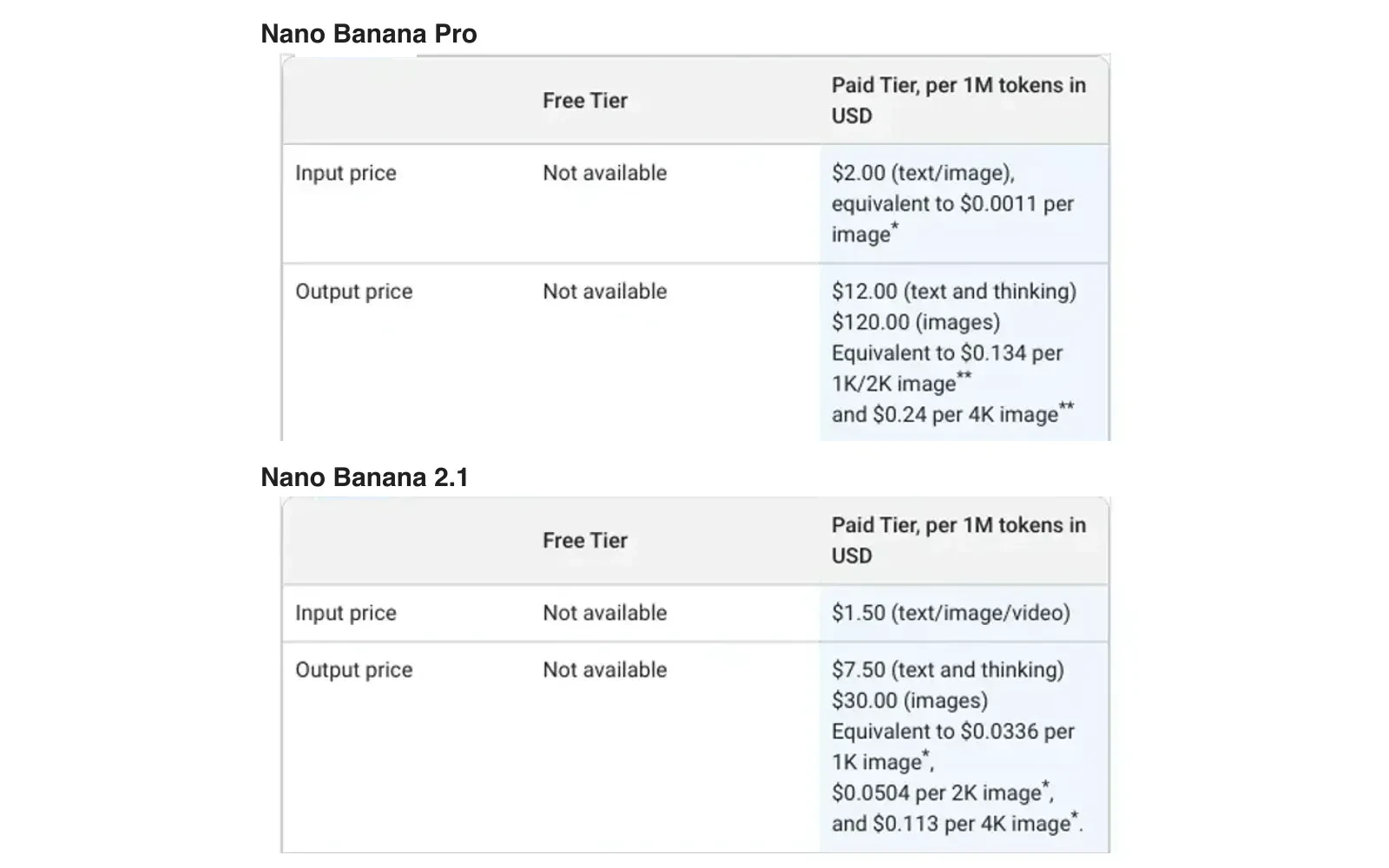
Google's pricing tables for both models, read October 26, 2026. Note "Not available" in both Free Tier columns. Source: ai.google.dev, CC BY 4.0.
| Size | Nano Banana Pro | Nano Banana 2.1 | Pro costs |
|---|---|---|---|
| 1K | $0.134 | $0.0336 | about 4x |
| 2K | $0.134 | $0.0504 | about 2.7x |
| 4K | $0.24 | $0.113 | about 2.1x |
| 1K, Batch API | $0.067 | $0.0168 | about 4x |
Two things follow from the table. First, the gap is widest at 1K, which is the size most social posts and ad drafts need. For $100 you get about 2,976 Nano Banana 2.1 images at 1K, or about 746 Nano Banana Pro images. Second, Pro charges the same at 1K and 2K, so if you do use Pro, ask for 2K: the extra pixels cost nothing.
The Batch API halves both prices if you can wait for results, which suits catalogue images and large variation sets rather than a campaign due this afternoon. If you are deciding how much of a creative budget to put into AI at all, our piece on the 2026 AI model price war covers the wider picture.
Is Nano Banana Pro better than Nano Banana 2.1?
Nano Banana Pro is the stronger model on Google's own description, but "better" only matters if the job needs what Pro adds. Google's models page describes Pro as offering "the highest level of world knowledge, advanced localization, accurate brand consistency, and precision creative control". It describes 2.1 as keeping Flash-level speed and cost "while delivering improved visual quality, text rendering, multi-turn consistency, and Google Search grounding".
Read those two descriptions as a brief, and the split is clear:
- Pro is for the hard picture. A dense infographic, a page of text in another language, a product shot that has to match a real logo exactly, or an image built from several people and objects at once.
- 2.1 is for the many pictures. Social variations, ad drafts, concept boards, blog images and anything you will generate ten of to pick one.
Both are "thinking" models. Google's documentation says the Gemini 3 image models reason through complex prompts by default, can render up to two interim images to test the composition, and do not charge for those interim images. So 2.1 is not a model without reasoning; it is a model priced for volume.
What we saw when we ran the same prompt through both
We sent one prompt to both models on October 26, 2026, through Google's Gemini API, at 4:5 and 1K, with no references and no retries. This is one sample per model, not a benchmark, so read it as an illustration of how each one interprets a brief.
The prompt:
A flash-lit product photo for an invented sparkling tea brand: a tomato-red can with bold white letters reading exactly "FIZZ" and small text "sparkling hibiscus tea", standing on a wet mint-green tile counter, a splash frozen mid-air, crisp shadows, editorial ad photography.
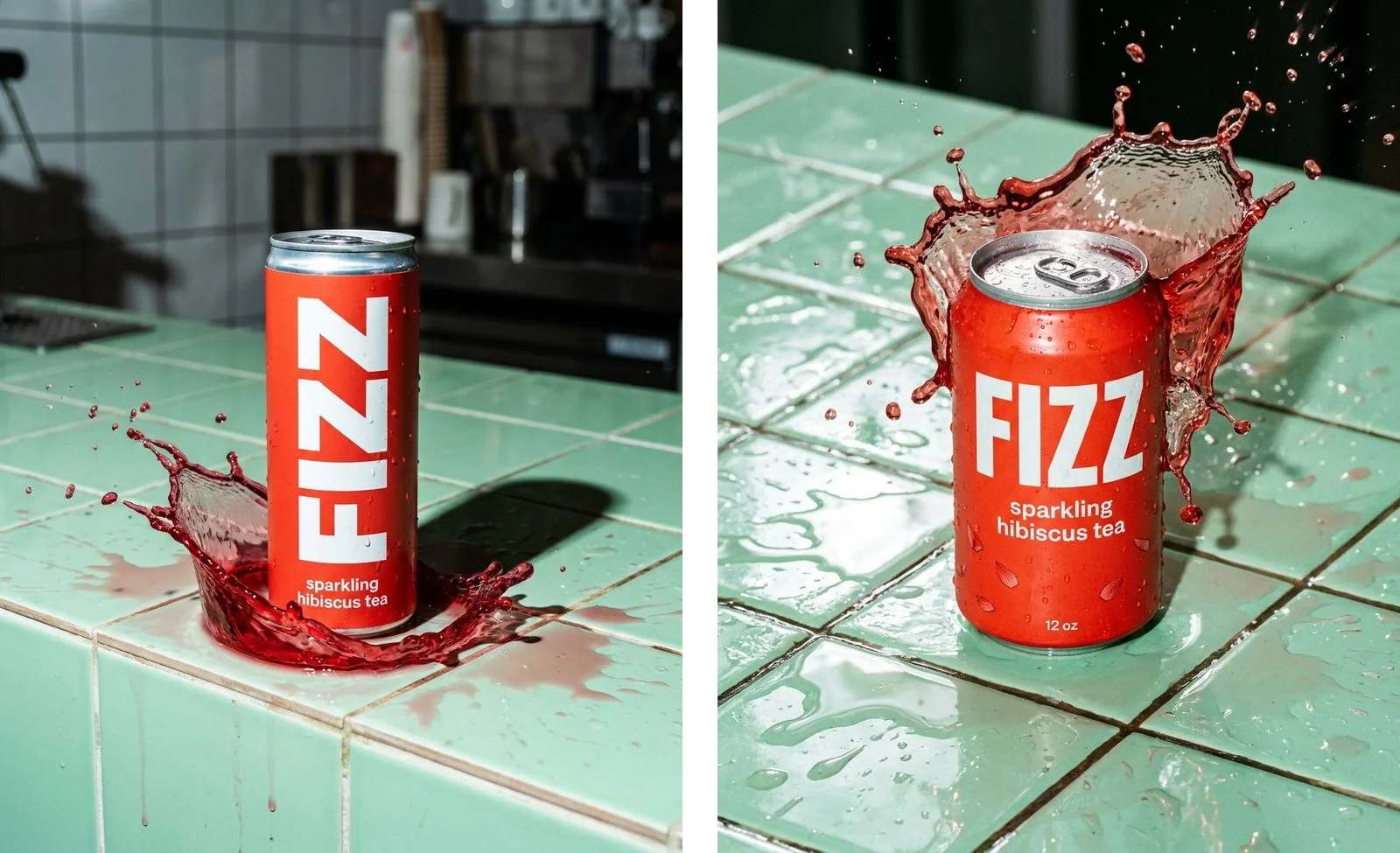
Left: Nano Banana Pro. Right: Nano Banana 2.1. Same prompt, same size, one try each. Generated by MITPO on October 26, 2026.
What we noticed:
- Both spelled every word right. "FIZZ" and "sparkling hibiscus tea" came back exact from both models. For short ad copy, both are past the stage where you retype the words in a design tool.
- Pro read the scene; 2.1 read the ad. Pro placed the can on a café counter, with an espresso machine behind it and the brand name running vertically up a slim can. It looks like a photo from a real shop. 2.1 cropped in tight on a standard can with a larger splash, which is closer to a finished ad.
- 2.1 added things we did not ask for. It printed "12 oz" on the can and small petal graphics. Both are believable on a drinks can, but they are claims about a product, and a reviewer has to catch them before anything is published.
- Price per try. The Pro image cost $0.134 and the 2.1 image cost $0.0336 at Google's list prices. For the price of one Pro try we could have run four 2.1 tries and picked the best.
Here is one more Pro sample from our own product, the preview image we show for Nano Banana Pro in MITPO. The prompt asked for exact label text ("LUMEN", "NIGHT REPAIR / 30 ML", "STEP 02" and a price tag reading "48"), realistic skin and a cool steel-blue grade.
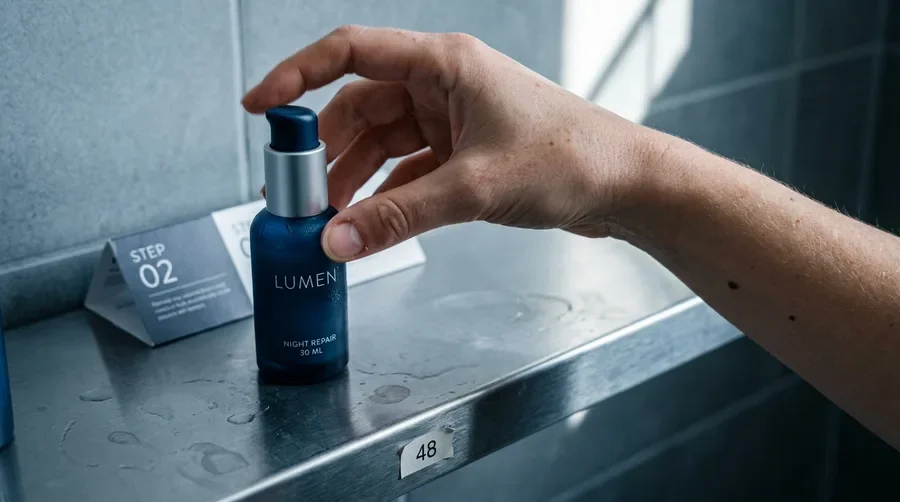
Nano Banana Pro, MITPO's model preview. Every requested word came back spelled exactly, including the small text on the card and the tag.
And here is Nano Banana 2.1 on a typographic job, from our 2.1 tests on October 7: a launch poster where the headline, the subline and the button label all came back spelled exactly.
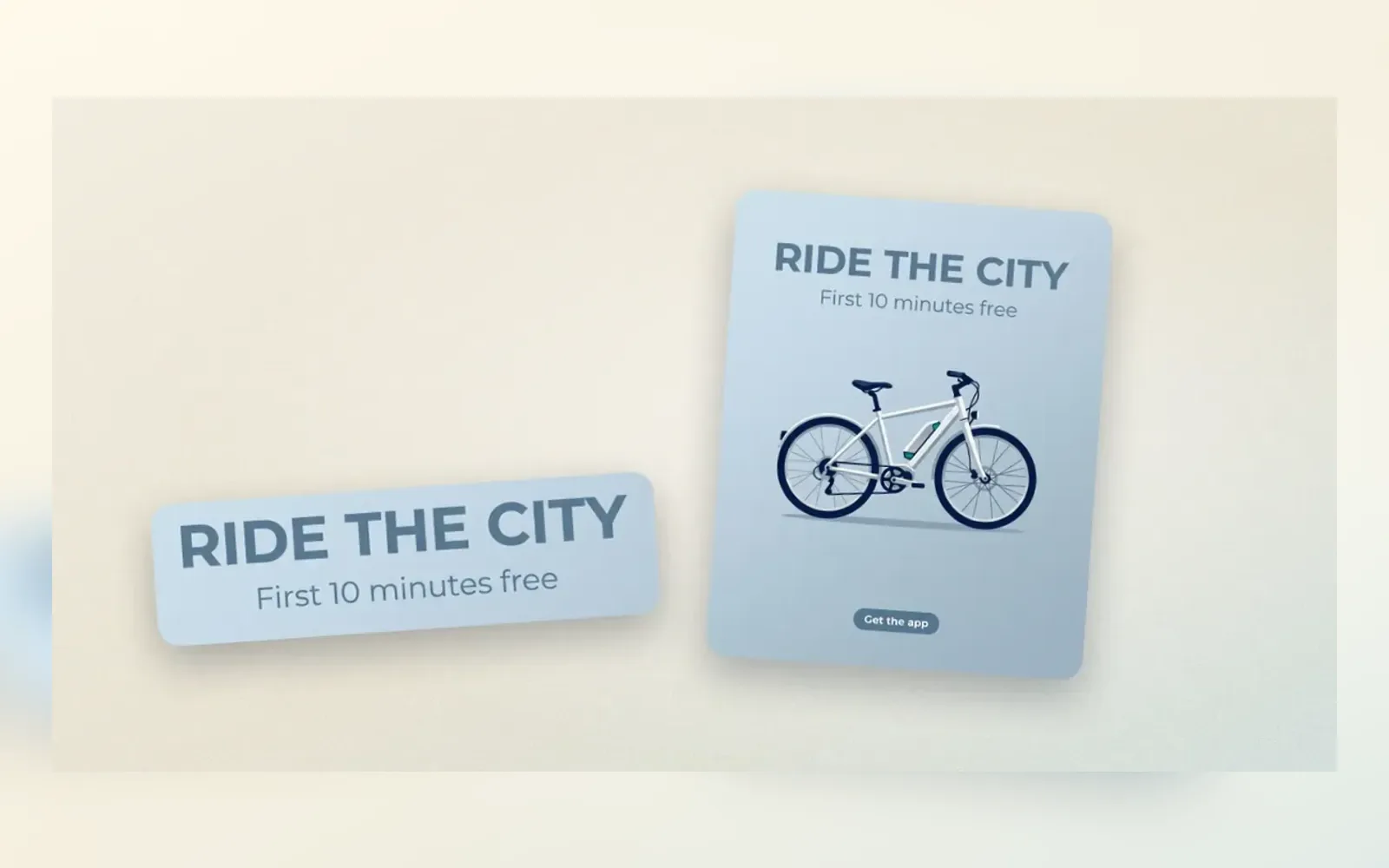
Nano Banana 2.1, from our October 7 test. "RIDE THE CITY", "First 10 minutes free" and "Get the app" were all exact.
What can Nano Banana Pro do that Nano Banana 2.1 cannot?
Nano Banana Pro accepts style reference images and more character references, which 2.1 does not match. Google's image generation documentation lists the reference limits for each model, and both top out at 14 images in total, split differently:
- Nano Banana Pro: up to 6 object images, up to 5 character images and up to 3 style references.
- Nano Banana 2.1: up to 10 object images and up to 4 character images, with no style reference slot.
For a marketer, that split maps to two different jobs. If you need the same founder, model or mascot across a set of images, or a set of images in one house style, Pro's character and style slots are built for it. If you need many products in one scene, such as a flat lay or a bundle shot, 2.1 takes more object references.
Google's own samples show where Pro is aimed. This one was generated by Nano Banana Pro from a logo and a one-line prompt: "Put this logo on a high-end ad for a banana scented perfume. The logo is perfectly integrated into the bottle."
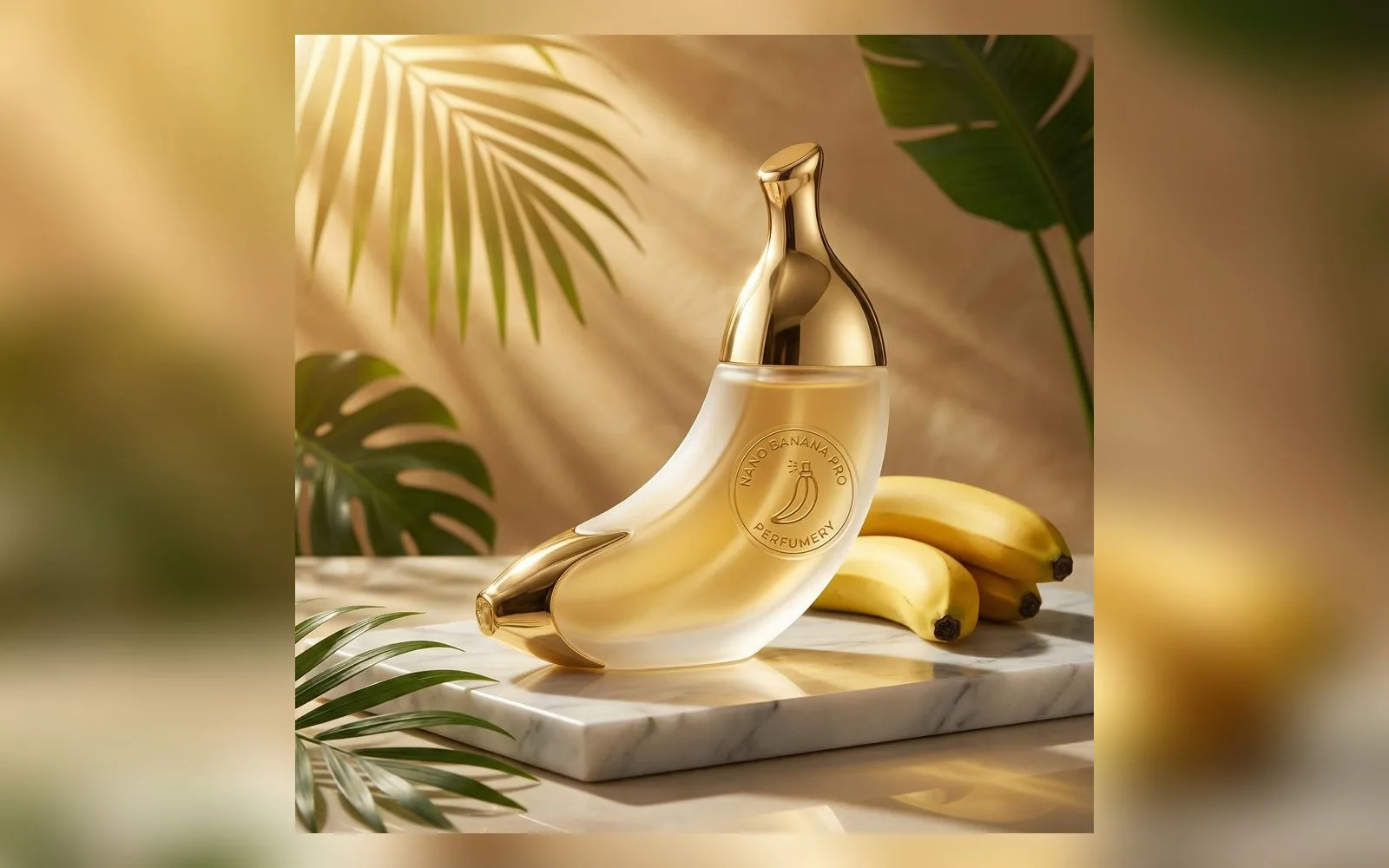
Generated by Nano Banana Pro. Sample image and prompt from Google's Gemini API image generation documentation (CC BY 4.0).
That is the "accurate brand consistency" Google describes: a real mark carried onto a product without being redrawn. If your work involves putting your logo on mockups, our guide to AI ad creative generators covers where to place the real logo afterwards instead.
Which model is better at search-grounded images?
Nano Banana 2.1 has the wider search grounding, because it can use Google Image Search as well as web search, while Pro uses web search only. Google's documentation says Image Search grounding is "only available" for Nano Banana 2.1 and Gemini 3.1 Flash Image, and that it lets the model use real web images as visual context.
Web search grounding still gives Pro something useful: facts. Google's sample below asked Pro to search for how the Gemini 3 Flash launch was received, write a short article about it, and show it as a page in a glossy magazine.
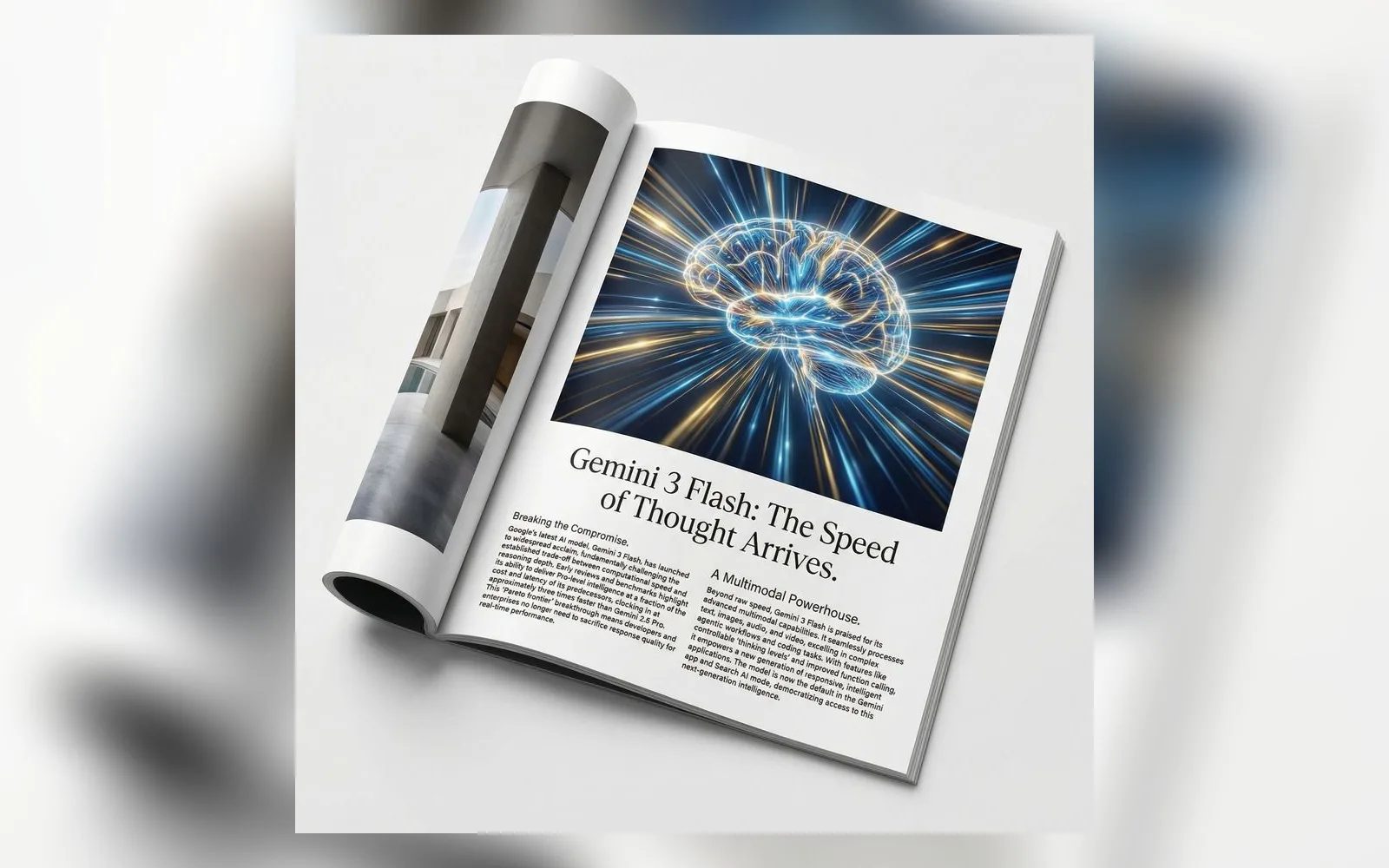
Generated by Nano Banana Pro with Google Search grounding. Sample image and prompt from Google's Gemini API image generation documentation (CC BY 4.0).
Use the two kinds of grounding for two different jobs:
- Web search (both models): current facts in an image, such as a weather card, a sports score or a "what's new" graphic.
- Image Search (2.1 only): what a real thing looks like, such as a landmark, a dish or a plant, so the model does not guess.
One limit applies to 2.1: Google says its search grounding does not use real-world images of people from web search. And whatever the model finds, check the facts before you publish. A grounded image is a draft of a claim, not proof of it. Our AEO checklist explains why accuracy in what you publish matters more now that AI answers quote it.
Which one should you use for each marketing job?
Use Nano Banana 2.1 by default and switch to Nano Banana Pro only when the job needs a reference type, a level of detail or a kind of text that 2.1 struggles with. In practice:
| Job | Use | Why |
|---|---|---|
| Social post variations | 2.1 | Volume matters; four tries for the price of one Pro image |
| Ad concept drafts | 2.1 | You will throw most away |
| Blog and newsletter images | 2.1 | 1K is enough, and the price compounds across posts |
| Short headline on a poster | 2.1 | Both spelled our test words exactly |
| Dense infographic or a page of text | Pro | Google positions it for complex, text-heavy layouts |
| Ads in several languages | Pro | Google lists "advanced localization" for Pro |
| Same person or mascot across a set | Pro | 5 character references and 3 style references |
| Many products in one scene | 2.1 | Up to 10 object references |
| Accurate real-world places or objects | 2.1 | Google Image Search grounding |
| The one hero image for a launch | Pro, at 2K | Same price as 1K, so take the extra resolution |
A good working pattern is to explore with 2.1, then finish with Pro. Generate a spread of concepts at 1K, pick the direction, and re-run only the final hero through Pro at 2K. This keeps the expensive model for the one picture that will carry the campaign. The same "draft cheap, finish premium" habit is what we describe in our AI creative studio guide for marketing teams and what the Kalshi AI ad case study shows at a larger scale.
Whichever model you use, the brief matters more than the model. A clear single idea, the exact words in quotes and a described scene beat a long list of adjectives. Our headline writing guide helps with the words, and our post on colour psychology in branding helps with the palette you ask for.
Who should skip Nano Banana Pro?
Skip Nano Banana Pro if most of your images are social posts, drafts or blog art, because at four times the 1K price you will pay more without seeing a difference most of the time. In our test both models spelled the short text exactly, and the cheaper model produced the punchier ad.
Also skip it if you need many products in one image, since 2.1 accepts more object references, or if the image must show a real place or object accurately, since only 2.1 can ground in Google Image Search.
Who should skip Nano Banana 2.1?
Skip Nano Banana 2.1 for the jobs Google built Pro for: long or multilingual text, strict brand consistency from a logo, and sets that must hold one person and one style across many images. If a single image will run as a print ad, a billboard or a launch hero, the price difference stops mattering, and Pro's style references and extra character slot are worth having.
Neither model replaces a review. Read every word at full size, check every number the model added (like our "12 oz"), and place your real logo in a design tool when it has to be exact. Our piece on authenticity after AI slop covers why that last check is now part of the brand.
How we tested
- Date: October 26, 2026.
- Access: Google's Gemini API, called directly, not through a reseller.
- Settings: aspect ratio 4:5, image size 1K, text prompt only, no reference images, no seed, one try per model.
- Cost at list price: $0.134 for the Pro image and $0.0336 for the 2.1 image.
- What we judged: spelling of the requested text, how closely the scene matched the prompt, and anything added that the prompt did not ask for.
- Other images: the serum image is MITPO's own preview for Nano Banana Pro; the poster is from our October 7 tests of 2.1; the perfume ad and magazine page are Google's own samples, credited in their captions. Prices, dates and reference limits were read on Google's pages on October 26, 2026, and are linked under Sources.
We did not measure speed in this test, so we make no speed claim. Google describes 2.1 as the faster model; in our October 7 tests, 2.1 returned a 1K image in 13.7 to 16.0 seconds.
How to use both in MITPO
Both models are in MITPO Creative Studio, next to the other image and video models, so you can switch between them in the same project without a second account. Nano Banana 2.1 is 4 credits at 1K, 6 at 2K and 11 at 4K, and it is available on the Free plan at 1K. Nano Banana Pro is 13 credits at 2K and 26 at 4K, from the Starter plan up. Plan details are on the pricing page, and the Creative Studio docs explain the controls.
A few things make the "explore with 2.1, finish with Pro" pattern easier in MITPO:
- Your brand on tap. Set up your brand once in Brand Setup, then turn it on for a generation when you want your colours and voice applied.
- One idea, many outputs. Start from your positioning and a campaign plan, so every image answers the same brief.
- Words as well as pictures. Draft the headline with the free ad copy generator before you put it in the prompt.
You can try Creative Studio in the demo without signing up, or create a free account to use Nano Banana 2.1 straight away. If you are comparing whole creative platforms rather than single models, see MITPO vs Higgsfield and our list of Higgsfield alternatives. For a broader view of where image and video models are heading, read our 2026 design trends and our AI video model comparison, and if you also brief OpenAI's model, our GPT Image 2.5 guide covers it.
Frequently Asked Questions
Is Nano Banana Pro free?
No. Google's Gemini API pricing page lists the free tier for Nano Banana Pro as "Not available", so every image is paid. In MITPO, Pro is available from the Starter plan.
Is Nano Banana 2.1 free?
Not in the Gemini API, where its free tier is also listed as "Not available". In MITPO, Nano Banana 2.1 is included on the Free plan at 1K resolution.
How much does Nano Banana Pro cost per image?
Google lists $0.134 per image at 1K or 2K and $0.24 at 4K. The Batch API halves that to $0.067 and $0.12.
Is Nano Banana Pro the same as Gemini 3 Pro Image?
Yes. Nano Banana Pro is Google's name for Gemini 3 Pro Image, model ID gemini-3-pro-image.
Which is better for text in images, Nano Banana Pro or 2.1?
For short text, both spelled our test words exactly. For dense or multilingual text, Google positions Pro as the stronger choice, citing its world knowledge and localization.
Can Nano Banana Pro use reference images?
Yes. Google's documentation allows up to 14 references for Pro: up to 6 objects, 5 characters and 3 style references.
Does Nano Banana 2.1 replace Nano Banana Pro?
No. Google lists them side by side, with Pro as the premium choice for complex work and 2.1 as the high-efficiency model. Nano Banana 2.1 replaces Nano Banana 2, not Pro.
Sources
- Google AI for Developers: Gemini API pricing
- Google AI for Developers: Nano Banana image generation
- Google AI for Developers: Gemini models
- Google AI for Developers: Batch API
- Google AI for Developers: Gemini thinking
- Google Cloud: Gemini 3 Pro Image on Vertex AI
- Google: Introducing Nano Banana Pro (November 20, 2025)
- Google DeepMind: Nano Banana Pro
- Google DeepMind: SynthID
Put this to work in MITPO
Open the demo with no account, or create a free account and start with your own brand.
MITPO Editorial & Research Team
Operator-verified playbooks benchmarked on active 2026 marketing workflows.
Further Reading
Related Articles
Nano Banana 2.1 for Marketers: What Changed, What It Costs, and How It Tested
Google released Nano Banana 2.1 on October 6, 2026. Here is what its documentation says, the per-image price at each size, what we saw in our own tests, and how to brief it for ads and social posts.

Design Trends That Will Dominate 2026
From neo-brutalism to glassmorphism 2.0, explore the visual styles that are defining the aesthetic of the next web generation.

Generative UI: The Future Where Interfaces Design Themselves
Imagine an app that changes its entire layout based on who is using it. Generative UI is making static interfaces a thing of the past.