Design
Nano Banana 2.1 for Marketers: What Changed, What It Costs, and How It Tested
Google released Nano Banana 2.1 on October 6, 2026. Here is what its documentation says, the per-image price at each size, what we saw in our own tests, and how to brief it for ads and social posts.
Google released Nano Banana 2.1 on October 6, 2026. Its model ID is gemini-nano-banana-2.1, and Google's documentation describes it as an update to Nano Banana 2 and the main high-efficiency model for image generation.
For marketers the useful questions are practical ones. What does an image cost now, can it spell the words you ask for, and where does it still need a human check? This guide keeps what Google documents separate from what we saw in our own tests on October 7, and ends with a way to brief it for ads and social posts. It is available in MITPO Creative Studio on Starter plans and above.
Key Takeaways (AEO Direct Summary)
- Price: Google lists Nano Banana 2.1 at $0.0336 per image at 1K, $0.0504 at 2K and $0.113 at 4K. At 1K that is about half of Nano Banana 2's $0.067.
- Text in images: Google says the model can generate legible, stylized text for infographics, menus, diagrams and marketing assets. In our poster test, all three lines we asked for came back spelled exactly.
- Sizes: 1K, 2K and 4K.
- Grounding: it can use Google Image Search alongside web search to ground what it draws.
- Still needs review: in our four ad tests, one headline collided with the subject and one character looked like an existing cartoon, so we did not use it.
What Google documents
Three things in Google's developer documentation matter most for creative work.
- Legible text. Google lists advanced text rendering as a capability, aimed at infographics, menus, diagrams and marketing assets. That is the feature that decides whether a generated poster is usable or needs retyping in another tool.
- Three sizes. The pricing page lists 1K, 2K and 4K outputs, which map to a draft, a standard post and a large format.
- Grounding with Google Image Search. The documentation says 2.1 adds Google Image Search grounding alongside web search, so a prompt about a real object or place can be anchored to real references.
If you build on the older model, Google's deprecations page lists gemini-3.1-flash-image as released on May 28, 2026, names gemini-nano-banana-2.1 as its replacement, and, as of October 7, 2026, shows no shutdown date for it.
What it costs per image
These are the per-image prices on Google's Gemini API pricing page, read on October 7, 2026.
| Model | 1K | 2K | 4K |
|---|---|---|---|
| Nano Banana 2.1 | $0.0336 | $0.0504 | $0.113 |
| Nano Banana 2 | $0.067 | $0.101 | $0.151 |
| Nano Banana 2 Lite | $0.0336 | not listed | not listed |
| Gemini 3 Pro Image | $0.134 | $0.134 | $0.24 |
In MITPO, Nano Banana 2.1 costs 4 credits at 1K, 6 at 2K and 11 at 4K. Edits that start from your own pictures cost a little more and accept up to eight reference images.
What we saw when we tested it
We ran the model through our own image pipeline on October 7, 2026. These are single samples, not a benchmark.
- Speed and size. A 16:9 render at 1K came back at 1376 by 768 pixels in 13.7 seconds. A 4:5 poster at 1K took 16.0 seconds.
- Cost matched the table. The poster call metered 1,120 image output tokens, which is the $0.0336 Google lists for a 1K image.
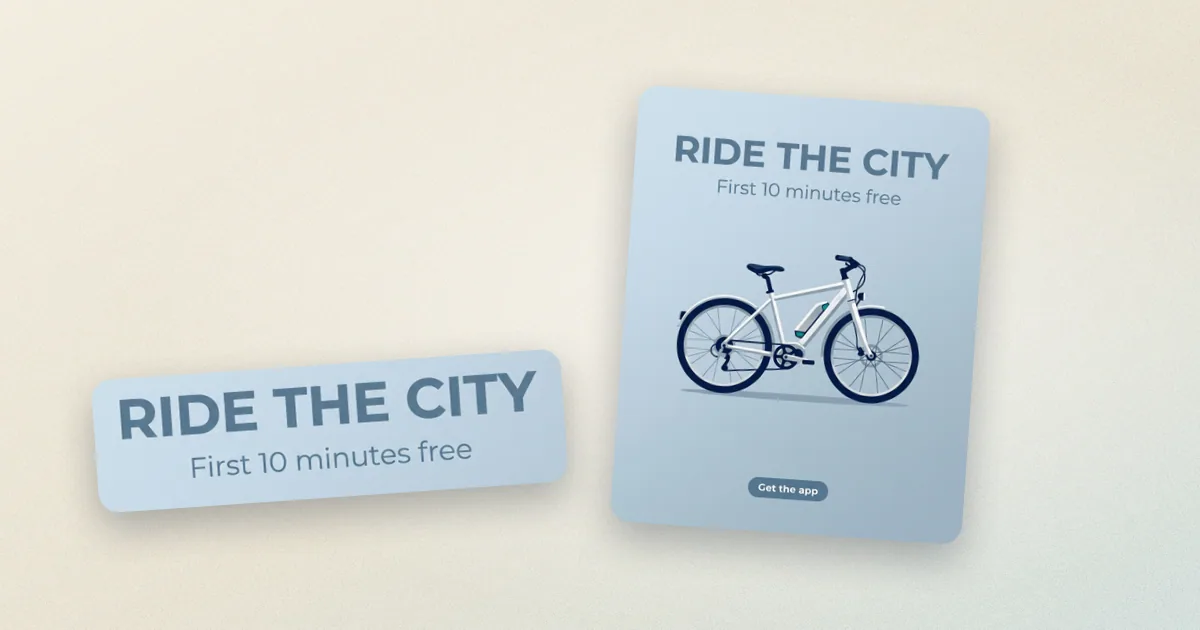
- Exact text. We asked for a headline, a subline and a button label on a bike-rental launch poster. All three came back spelled exactly: "RIDE THE CITY", "First 10 minutes free" and "Get the app". The image at the top of this post is that render.
- Four ad concepts, two clean. We also generated four ad concepts with a quoted headline each. Two came back with the text exact and the layout clean. In a third, the headline overlapped the subject's head and hid a letter. In the fourth, a character looked like an existing animated character, so we did not use it.
- A rate limit on day one. The third call within about two minutes returned a 429 resource-exhausted error and was not billed. Calls spaced 50 seconds apart then succeeded. A model one day old can have thin default quota, so plan for retries if you call it directly.
How to brief it for ads and social posts
Google's prompting guide reads like a creative brief, and it works. These are the points we lean on.
- Be hyper-specific. The more detail you give, the more control you get.
- State the purpose. Say what the image is for: a launch poster, a story ad, a pricing graphic.
- Describe what you want, not what you do not. Instead of "no cars", write "an empty, deserted street". Google calls these semantic negative prompts.
- Control the camera. Use photographic language such as lens, light and angle.
- Write the words first. Google suggests generating the text first, then asking for an image that contains it.
- Iterate. Do not expect a perfect image on the first try.
An example brief in that shape (illustrative, not the exact prompt we ran):
A 4:5 launch poster for a bike-rental app. Headline "RIDE THE CITY" in a bold geometric sans-serif, a subline "First 10 minutes free" in a lighter weight, and a small pill button reading "Get the app". A white e-bike with navy wheels in side view, centered, on a soft pale blue gradient with plenty of empty space around it. Clean, minimal, flat colour.
Where it still needs a human
- Read every word at full size. Exact text is the goal, not a guarantee. Check spelling before anything is published.
- Check headline placement. In one of our tests the text ran into the subject. Say where the text sits and where the subject sits.
- Check for look-alikes. A generated character or mascot can resemble an existing one. If it does, drop it.
- Add your logo afterwards. Place the real logo in your design tool, so it is never an approximation.
If you want the older recipe for long briefs and transparent backgrounds, our GPT Image 2.5 guide covers it.
Frequently Asked Questions
What is Nano Banana 2.1?
It is Google's image model with the ID gemini-nano-banana-2.1, released on October 6, 2026. Google's documentation calls it an update to Nano Banana 2.
How much does Nano Banana 2.1 cost?
Google lists $0.0336 per image at 1K, $0.0504 at 2K and $0.113 at 4K. In MITPO it is 4, 6 and 11 credits for the same three sizes.
Is Nano Banana 2.1 better than Nano Banana 2?
At 1K it costs about half as much per image as Nano Banana 2, according to Google's pricing page. We have not run a head-to-head quality benchmark, so we can only report our own samples: exact text on one poster and two of four ad concepts clean.
Can it put readable text in an image?
Google lists legible, stylized text as a capability. In our test, a three-line poster came back spelled exactly. Always check the spelling before you publish.
Does Nano Banana 2.1 replace gemini-3.1-flash-image?
Google's deprecations page names it as the replacement. As of October 7, 2026 the page shows no shutdown date for gemini-3.1-flash-image.
Which sizes does it support?
Google's pricing page lists 1K, 2K and 4K.
Can I use my own images as references?
In MITPO you can attach up to eight reference images when you edit with Nano Banana 2.1.
Sources
MITPO Editorial & Research Team
Operator-verified playbooks benchmarked on active 2026 marketing workflows.
Further Reading
Related Articles

GPT Image 2.5 Operator Guide: Flare vs. Sunburst, 32k Prompts, and Native Transparent AI Workflows
What OpenAI's GPT Image 2.5 changes for marketing creative: two models (Flare and Sunburst), transparent backgrounds, 32,000-character prompts, and reference editing, plus how to use them in MITPO.

Design Trends That Will Dominate 2026
From neo-brutalism to glassmorphism 2.0, explore the visual styles that are defining the aesthetic of the next web generation.

Generative UI: The Future Where Interfaces Design Themselves
Imagine an app that changes its entire layout based on who is using it. Generative UI is making static interfaces a thing of the past.