Strategy
Product-Led vs. Sales-Led Growth: The Ultimate 2026 Playbook
The battle between growth motions continues. We analyze when to let the product sell itself and when to pick up the phone.

Product-Led vs. Sales-Led Growth: The Ultimate 2026 Playbook
Should you hire ten more sales reps or ten more engineers? Should you build a free tier or a gated demo request? The "PLG vs. SLG" debate is one of the most important strategic decisions a modern software company will make.
The answer, as always, is "it depends." But in 2026, the lines are blurring, and a new hybrid model is emerging as the winner.
What is Product-Led Growth (PLG)?
PLG relies on the product being so good and so easy to use that it essentially sells itself. Users sign up for free, experience the value (the "Aha!" moment), and then convert to paid customers - often without ever talking to a salesperson.
Examples: Zoom, Slack, Dropbox, Canva, Notion, Figma.
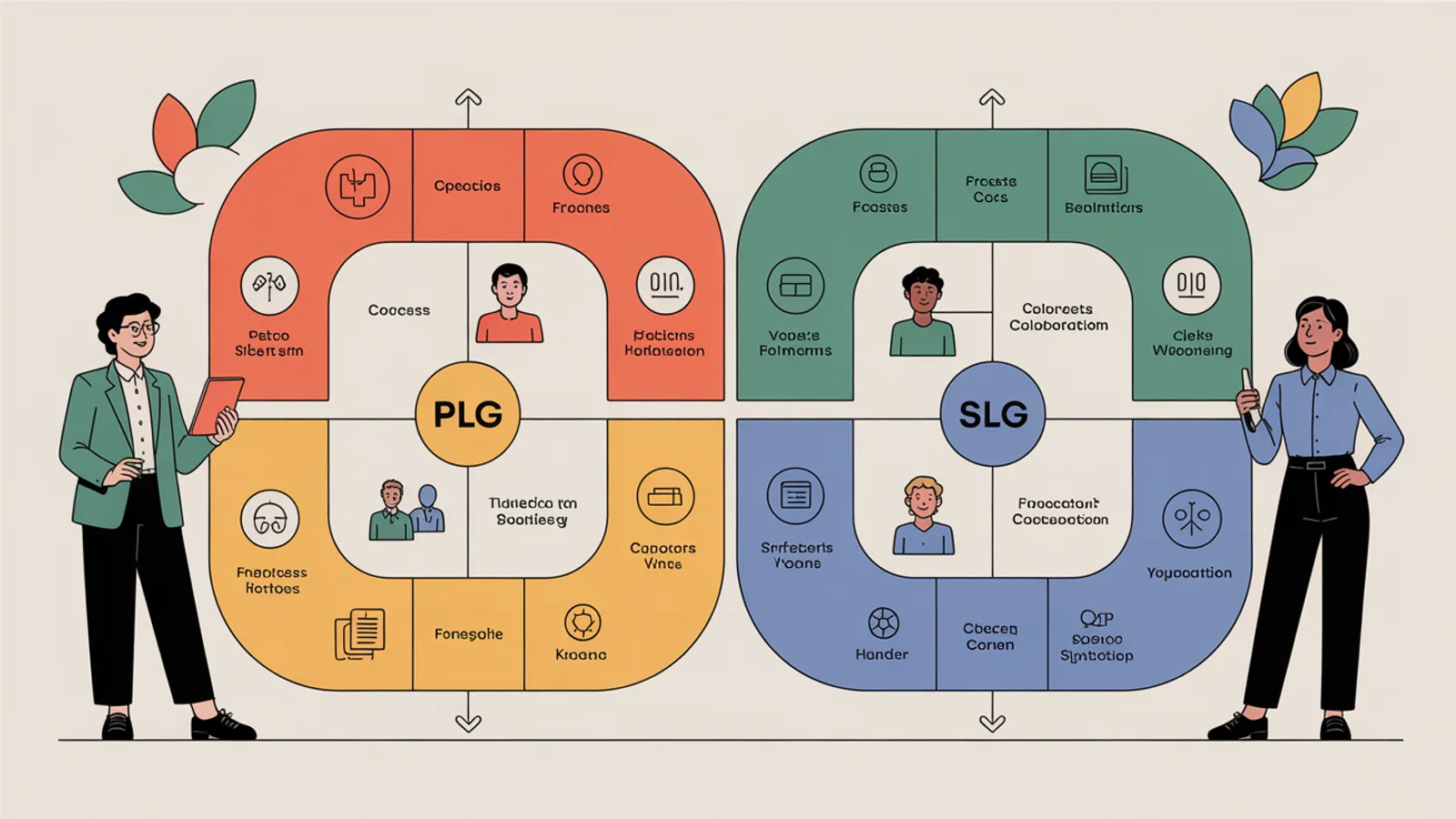
Pros of PLG:
- Lower CAC (Customer Acquisition Cost): No expensive sales team eating into margins.
- Wider Top-of-Funnel: A free tier attracts a massive user base.
- Faster Time-to-Value: Users can experience the product immediately.
- Better User Experience: The product has to be great; there's no salesperson to smooth over rough edges.
Cons of PLG:
- Hard to close massive enterprise deals. A CISO isn't signing a six-figure contract without talking to a human.
- High churn if the product isn't sticky. Users come in easy, but they leave easy too.
- Requires a world-class product. Not every product is suitable for self-service.
What is Sales-Led Growth (SLG)?
SLG involves a dedicated sales team actively pursuing leads, conducting demos, handling objections, and closing contracts. It's the traditional model for enterprise software.
Examples: Salesforce, Oracle, Workday.
Pros of SLG:
- Higher ACV (Average Contract Value): Salespeople can negotiate larger, multi-year deals.
- Better for complex solutions. Some products genuinely need explanation and customization.
- Stronger customer relationships. A named account manager builds loyalty.
Cons of SLG:
- Expensive. Salaries, commissions, and travel costs add up quickly.
- Harder to scale linearly. Hiring and training salespeople takes time.
- Longer sales cycles. Enterprise deals can take 6-12 months.
The 2026 Winner: Product-Led Sales (PLS)
The winning strategy for most B2B SaaS companies in 2026 is a hybrid model called Product-Led Sales (PLS).
How it works:
- Start with PLG: Let users sign up for free, experience the product's value, and reach an "Aha!" moment on their own.
- Identify Product-Qualified Leads (PQLs): Use product analytics to monitor usage. Who is a heavy user? Who invited their teammates? Who hit a usage limit?
- Layer on Sales: Your sales team monitors these PQLs. When they see a signal of high intent (e.g., a user from a Fortune 500 company invites 10 colleagues), then they reach out. "Hey, looks like your team is getting a lot of value from the platform. Want to explore an Enterprise plan with SSO and priority support?"
It's sniping, not carpet bombing.
The lead is already warm. They already love the product. The sales conversation is about expansion and closing, not about convincing them the product is valuable. This dramatically increases close rates and reduces sales cycle time.
Next step
Turn this into a practical workflow with the campaign planning guide.
MITPO Editorial & Research Team
Operator-verified playbooks benchmarked on active 2026 marketing workflows.
Further Reading
Related Articles

Buffer Alternatives for Startups in 2026: What Actually Matters
A practical guide to choosing a Buffer alternative when your team needs planning, drafting, review, and publishing without adding more operational drag.

Schema Markup That Actually Moves the Needle for SaaS in 2026
Most schema markup advice is a copy-paste of Google's documentation. Here are the six schema types that actually changed our clients' click-through rates in 2025-2026, and the four that waste your time.

Programmatic SEO Without Getting Penalized: The 2026 Playbook
Programmatic SEO still works in 2026 - but not the way 2022 guides tell you to run it. The shape that survives Google's updates is narrower, more data-driven, and genuinely useful to the reader.